


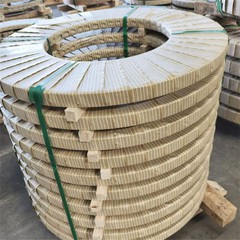


321 vs 347 Austenitic Stainless Steels: Titanium vs Niobium-Stabilized High-Temperature Grades
Jan 05, 2026
Ostavite poruku


321 contains 17–19% Cr, 9–12% Ni, 0.4–0.8% Ti, with titanium binding carbon to form stable carbides. It maintains structural integrity up to 800℃, ideal for industrial furnace parts.347 features 17–19% Cr, 9–13% Ni, 0.7–1.0% Nb (plus Ta), with niobium carbides that resist coarsening at temperatures up to 900℃, making it suitable for aerospace high-heat components.Both grades eliminate post-weld heat treatment, a critical advantage over standard 304 for welded high-temperature assemblies.
At >800℃, 321's titanium carbides begin to coarsen, reducing grain boundary strength and creep resistance over prolonged exposure.347's niobium carbides remain fine even after thousands of hours at 850–900℃, minimizing thermal fatigue in cyclic heating/cooling scenarios (e.g., gas turbine exhausts).In steam systems, 347's stability extends component lifespan by 2–3 times compared to 321.
Choose 321 for moderate high-heat welded parts: boiler tubes, automotive exhaust headers, and thermal processing fixtures operating below 800℃.Opt for 347 for ultra-high-temperature or nuclear-grade applications: jet engine combustion chambers, satellite structural components, and nuclear power plant steam lines.
What are the cost and fabrication trade-offs between the two grades?
321 is 10–15% cheaper than 347 (titanium is more abundant than niobium), making it the economical choice for non-extreme high-heat uses.347 requires tighter welding heat control to avoid niobium carbide agglomeration; 321 is more forgiving for general fabrication.Both weld well with matching fillers (321/347), but 347's higher strength needs thicker welds for load-bearing parts.
321 is unsuitable for service above 800°C-its carbides will degrade, leading to creep deformation.347 is over-specified for low-temperature applications; use 321 or 304H to save cost.Prioritize 321 for moderate high-heat welded assemblies; select 347 for >800℃ or nuclear-critical components.
Pošaljite upit